
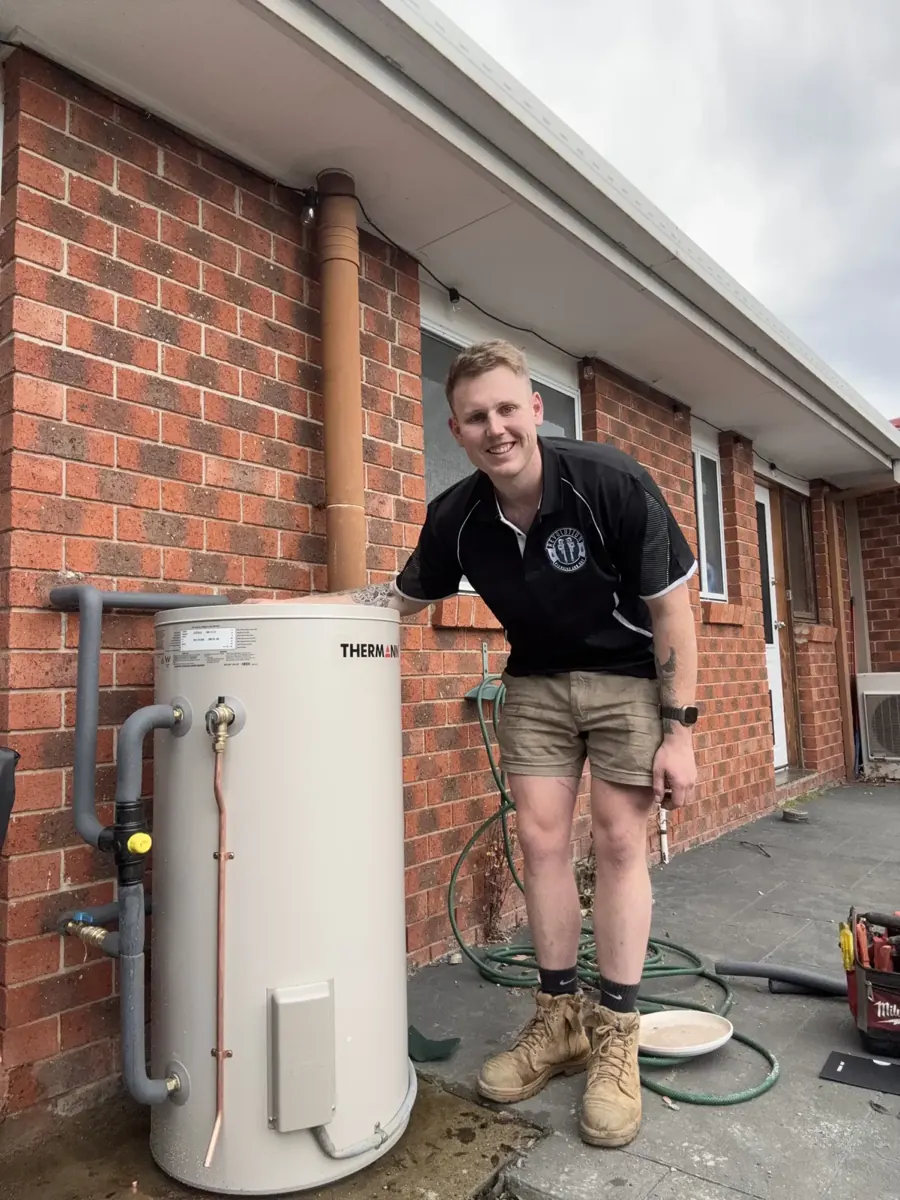
Gas vs electric vs solar hot water: Which is best for Canberra?
You have four choices in Australia: gas storage, electric storage, solar, and heat pump. In Canberra the heat pump usually wins on running cost once you count the ACT rebates, but gas storage is still the most common thing we install because it recovers fast and does not care how cold the morning is. Here is how the four stack up.
What are the pros and cons of gas hot water?
Gas storage is the most common system in Canberra homes. A gas burner heats a tank of water and keeps it hot until you want it. According to Hipages, the unit costs between $900 and $2,000, plus $500 to $1,500 to install.
- In its favour: gas reheats a tank quickly, it performs the same in the middle of a Canberra winter as it does in January, it costs less to run than electric storage, and it needs no roof space.
- Against it: you need a gas connection, older pilot light models burn gas around the clock doing nothing, a full tank slowly loses heat overnight, and the unit will not last as long as a heat pump.
- It suits homes that already have natural gas connected, households getting through a lot of hot water during the day, and places with no useable roof for solar.
- Expect 8 to 12 years out of one.
- Running cost is roughly $400 to $700 a year on natural gas.
Gas instantaneous units (continuous flow) are the other option. No tank, so no heat sitting there going cold, and the water heats as it passes through. They cost more to buy and they work out well for smaller households.
What are the pros and cons of electric hot water?
Electric storage is a big kettle: an element inside an insulated tank. Cheapest to buy and install, dearest to run, by a long way. According to ServiceSeeking, the unit runs $500 to $1,500, plus $300 to $1,000 to install.
- In its favour: the lowest upfront cost of the four, a straightforward install, no gas connection needed, and you can get them in almost any size.
- Against it: the highest running cost of any type, slow to reheat once you empty the tank, no government rebate, and the plumbing code will not let you put a conventional one into a new build.
- It suits a like-for-like replacement where the existing system is electric, switching is not practical and the budget is tight. Landlords often end up here for the same reason.
- Expect 8 to 12 years.
- Running cost is roughly $700 to $1,200 a year.
Electric storage is not banned in the ACT, but the plumbing code makes it very hard to use in a new house. Clause B2D2 of the Plumbing Code of Australia, which the ACT gives effect to through the Water and Sewerage Act 2000, requires the water heater in a new Class 1 or Class 10 building to be solar, a heat pump, a five star gas unit or a wood fired unit. An electric resistance heater is permitted only where it has no storage or delivers no more than 50 litres, and even then only in limited cases. A 250 or 315 litre tank does not fit through that gap. Builders can step around B2D2 by signing the house off on whole of home energy rating software instead, though a resistance element uses so much of that energy budget it is rarely worth attempting. Checked August 2026.
None of that touches an existing home. If your tank has just died you can still replace it like for like. Do the sums on an upgrade first though, because the rebates change the maths.
What are the pros and cons of solar hot water?
Solar heats the water in roof-mounted panels, with an electric or gas booster to cover cloudy stretches and winter. Canberra averages 7.7 hours of sunshine a day in summer, so the panels do real work for a good part of the year. Installed, expect somewhere between $3,000 and $7,000.
- In its favour: the lowest running cost of the four, a long life out of the panels, and it qualifies for government rebates.
- Against it: the highest upfront cost, and it only works if you have the right roof, ideally north-facing with nothing shading it. You will be running the booster through winter, and our frosts are hard on panels.
- It suits owner-occupiers with a good roof who intend to stay put long enough to get the upfront cost back.
- Panels last 15 to 20 years. The tank and booster are more like 8 to 12.
- Running cost is roughly $100 to $300 a year, which is the booster.
What are the pros and cons of heat pump hot water?
A heat pump works like a reverse-cycle air conditioner running backwards. It pulls heat out of the outside air and puts it into the water. It uses about a third of the electricity a standard electric unit does, which is where the savings come from. Supplied and installed in Canberra it runs $2,500 to $5,500, and our hot water system cost guide sets out what pushes a job to the top of that range.
- In its favour: very low running costs, ACT rebates apply, nothing goes on the roof, and it runs on electricity, so rooftop solar PV can carry most of the load.
- Against it: it costs more upfront than gas or electric, the fan unit makes noise so where you put it matters, it needs outdoor space, and efficiency does drop when it gets properly cold. Current units cope with Canberra winters, but that was a fair criticism of the older ones.
- It suits anyone chasing the lowest cost over the life of the system, houses that already have solar PV, and people trying to get off gas.
- Expect 10 to 15 years.
- Running cost is roughly $200 to $400 a year.
How do the four types compare?
| Factor | Gas Storage | Electric Storage | Solar | Heat Pump |
|---|---|---|---|---|
| Purchase + Install | $1,400 to $3,500 | $800 to $2,500 | $3,000 to $7,000 | $2,500 to $5,500 |
| Annual Running Cost | $400 to $700 | $700 to $1,200 | $100 to $300 | $200 to $400 |
| Lifespan | 8 to 12 years | 8 to 12 years | 15 to 20 years | 10 to 15 years |
| ACT Rebates | No | No | Concession card holders only | Concession card holders only |
| Cold Weather | Excellent | Good | Needs booster | Good (modern units) |
What ACT government rebates are available?
Two ACT programs apply to hot water, and both are narrower than most people assume. Checked August 2026.
- The Home Energy Support Program pays 50 per cent of the supply and installation cost of a hot water heat pump or an evacuated tube solar hot water system, capped at $2,500, with a maximum of $5,000 per property across the program's product categories. To qualify you have to own and live in the home, hold a Pensioner Concession Card, DVA Gold Card or Health Care Card, sit under the unimproved value threshold for the property, attend a free workshop, and have the application approved before the unit goes in. The model also has to appear on the Victorian Energy Upgrades register, which the ACT uses as its product list.
- The Sustainable Household Scheme lends $2,000 to $20,000 for energy efficient upgrades, hot water included, at 3 per cent following the change on 1 July 2026. The zero interest version, up to $10,000, applies only to households approved for a Home Energy Support rebate.
If you do not hold one of those concession cards, the rebate is not available to you and the loan is the only assistance on offer. A heat pump then has to justify itself on running cost alone, which over ten years it generally does. Amounts and eligibility get adjusted, so check both pages above before you budget on a figure, and our guide to heat pump hot water in Canberra goes through the eligibility conditions in more detail.
Which hot water system is best for your Canberra home?
It comes down to your house, your budget, and how long you are staying. Roughly:
- Older home with gas already on. Gas storage is the simplest swap. If the running cost bothers you, price a heat pump as well, with the rebate applied if you qualify for it.
- New build. Heat pump or electric boosted solar. New homes in most Canberra zones cannot get a new gas connection, so gas is off the table before you start comparing.
- Apartment or townhouse. Space is usually the constraint, so a gas instantaneous unit or a compact heat pump.
- House with solar PV on the roof. Pair it with a heat pump. Run the heat pump in the middle of the day on power you are otherwise exporting for very little, and your hot water costs you almost nothing.
Whichever you pick, have a licensed plumber install it. It is a safety requirement, and most manufacturers will void the warranty on a unit that was not installed by a licensed tradesperson. Our hot water system service covers supply, installation and connection for all four types, and we do the gas fitting ourselves if you go with gas.
Need help with this?
Call Jack. We will tell you what actually suits your house and your budget.